
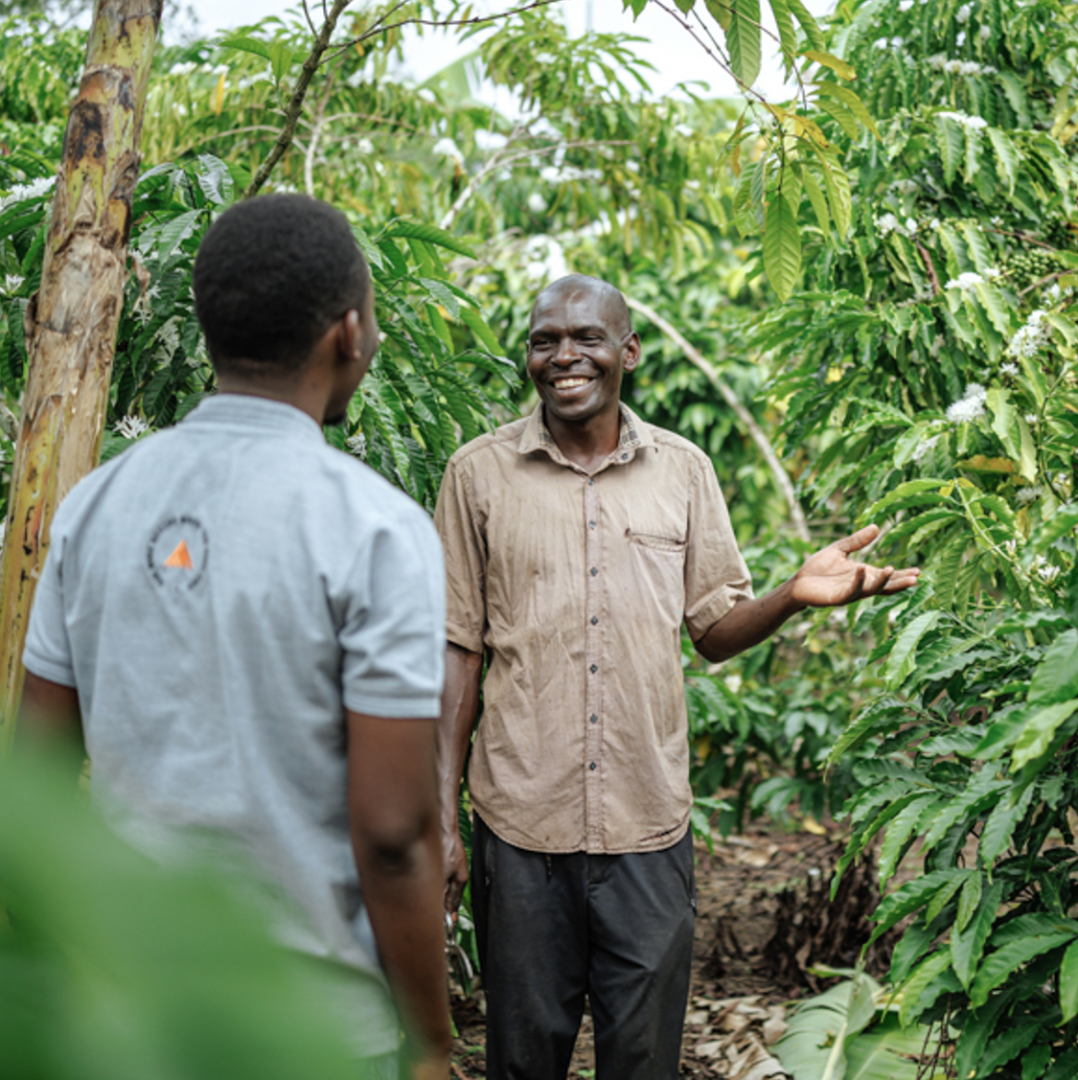

Income is what we measure.
But behind every number is a household with a story —
and we wanted to hear it.
When income rises in a smallholder household, what actually changes? It is a question that monitoring and evaluation data alone cannot fully answer. At HereWeGrow, income is our core impact metric — and for good reason. It is measurable, comparable across contexts, and a reliable signal that a household’s situation is improving. But income is also a means, not an end. The end is a better life.
This is why, alongside the numbers, we wanted to see what change looks like on the ground.
What the data shows
In Kitagwenda, western Uganda, we fund a project implemented by our partner Raising the Village (learn more about the project). After 18 months, monitoring data from the community paints an encouraging picture.
Average household income per person per day rose by 96% — from $0.96 to $1.35.

Fig. 1: Average increase in household income (RTV monitoring data)
The community-wide distribution tells an equally striking story: at baseline, 60% of households earned less than $0.75 per day, and fewer than 10% earned above $1.25. After 18 months, those figures had shifted substantially — the share earning less than $0.75 per day dropped to under 5%, while 40% of households had moved above $1.25 per day. It shows: the gains are not concentrated at the top. They are broadly shared.
Beyond income, the share of households reporting an improvement in their quality of life grew from 40% to 59%.

Fig. 2: Average household income distribution across the community (RTV monitoring data)
These shifts are driven by three interconnected levers in Raising the Village’s approach: health improvements through WASH investments and access to clean water; productivity gains through agronomic advice, improved seeds, and crop diversification; and business development through village savings and loan associations (VSLAs), bulk marketing, and small business support.
A note on the data: all figures are community averages based on project monitoring, with no control group. We have commissioned an independent RCT evaluation through Laterite, with midline results expected in 2027 and endline in 2029. That evidence will tell us with greater confidence what is working — and why.

When data meets people
Numbers can describe a trend and give us an overview. However, they do not tell us about a kitchen, a farm, or a plan for the future. To understand what the data reflects in practice, we visited households in the project area — listening, observing, and documenting alongside the Raising the Village local team, who led all conversations in participants’ language.
What follows are three of the households we met.
Daniel & Joy
Daniel (42) and Joy (38) are married with six children. Eighteen months into the program, the changes to their daily life are visible and deliberate.
They have built a latrine, constructed a dishwashing rack, and started a keyhole kitchen garden — adding fresh vegetables, and entirely new foods, to their family’s diet. Their 100 coffee trees continue to be the backbone of their income, and new composting and pest control techniques are already improving their yields.
Each of these steps is small on its own. Together, they represent a household that is actively investing in its own resilience — in health, in nutrition, in the farm.
Their next milestones are already in sight: a better roof, investments in their coffee plantation and expansion of the farm.


“We want to make more improvements to our house. The roof is especially important. But we also want to invest in our coffee plantation and, if possible, buy land so that we can give our children a good education.”
Kisembo
Kisembo is 21 years old and runs a single-headed household. He left his parents’ home and now supports his younger brother, paying his school fees through income from coffee farming and small-scale coffee trading.
Young, single-headed households are among the most economically vulnerable — with the least land, the least buffer, and the fewest people to share the work.


What Kisembo demonstrates is that the program can reach and benefit households at this end of the spectrum too.
His plans for the farm are concrete and ambitious. Coffee, he says, is the biggest income earner by far, and he wants to expand. And when asked what he would do with additional income, his answer is precise: a proper bed, chairs, a table — and then, a motorbike.
Mohammed
Mohammed is 52, a dedicated coffee farmer, and the head of a household of five. His farm is larger than average, and coffee has already allowed his family to build a concrete house — a significant asset in the community.
After 18 months in the program, Mohammed’s insight was an unexpected one: health, he realized, was holding back his income. Sick days meant less time on the farm.
Together with his family, he decided to invest in a new latrine. It is a small intervention with a direct and lasting return — better health, more time working, lower healthcare costs.
His story illustrates something the program’s design builds on explicitly: that health is not separate from productivity. It is a precondition for it.


Beyond individual households
The stories above take place within a wider web of community activities. In each village, project participants come together in village savings and loan associations — saving collectively, accessing small loans, and building small businesses together. They gather to learn new farming techniques side by side, strengthening both yields and community ties. These collective dimensions of the program — and what they look like in practice — are worth exploring in the full report.
What numbers can and cannot tell us
Income is a relevant primary metric. It is tangible, it compounds over time, and it opens doors — to education, to investment, to security. The community-level data from Kitagwenda suggests those doors are beginning to open.
But the visits to Daniel and Joy, Kisembo, and Mohammed reminded us that behind every average is a specific household with specific choices, priorities, and dreams. A roof. A motorbike. A latrine. These are not footnotes to the data — they are what the data is about.
This is why we plan to return to the same households over time, building a longitudinal picture of how lives change as income grows. The RCT evaluation through Laterite will tell us, with rigorous evidence, what is working and why. The household visits will help us understand what that means on the ground.
Together, we think, data and photos tell a more complete story.
Explore more data, pictures and stories in the full report.
📷 Photos by Jjumba Martin, Daniel Boklage
Project participants featured in this article shared their stories and agreed to be named. We are grateful for their openness. Conversations were led by the Raising the Village local team in participants’ language.