

A comparative look at two Ethiopian coffee agronomy programs shows why context matters – and how stumping can drive impact.
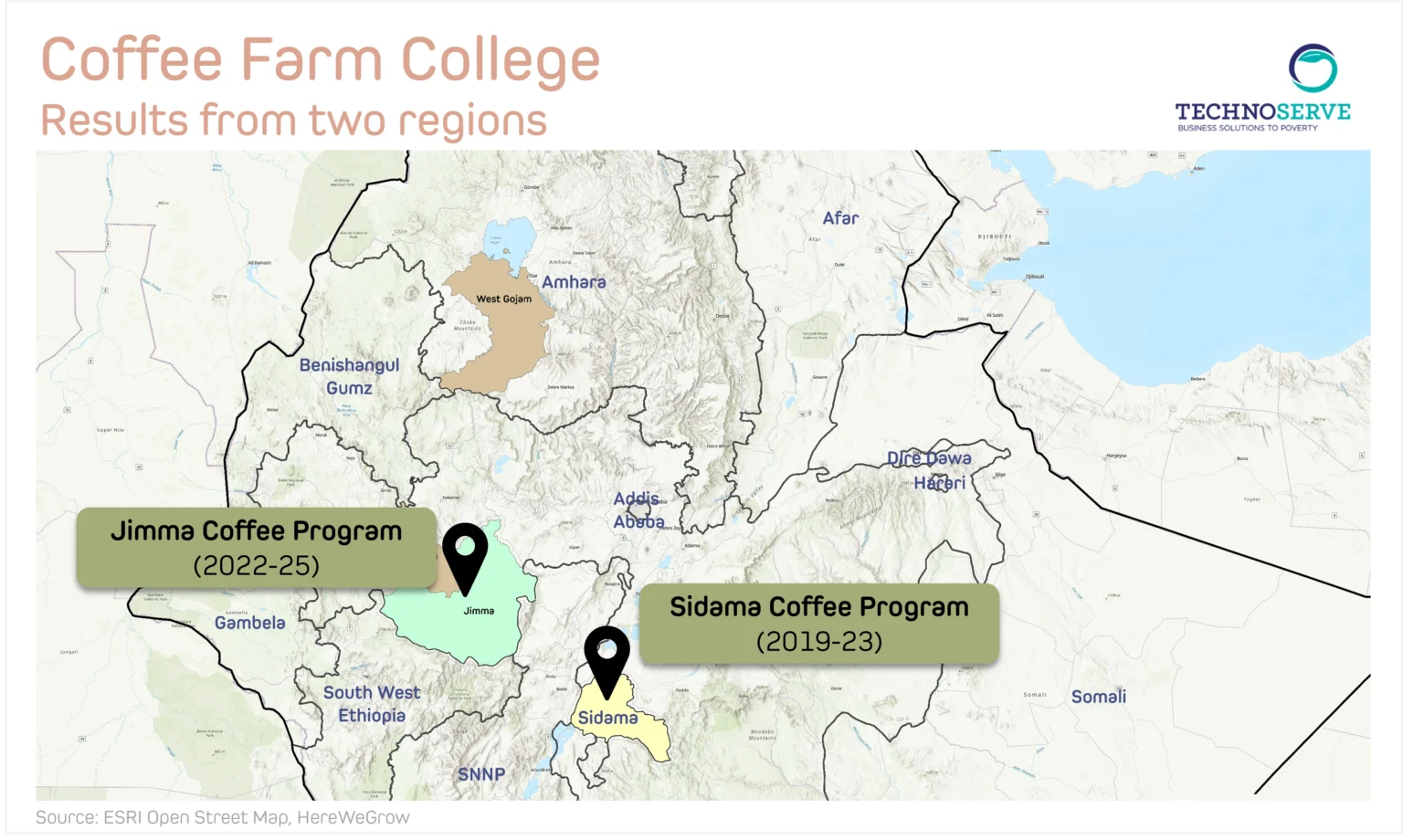
When we began supporting smallholder coffee farmers in Sidama and Jimma – two coffee growing regions in Ethiopia – both programs were built on the same approach: TechnoServe’s Coffee Farm College, a structured two-year training program on coffee Good Agricultural Practices (GAPs).
Despite a similar approach, the outcomes diverge considerably:
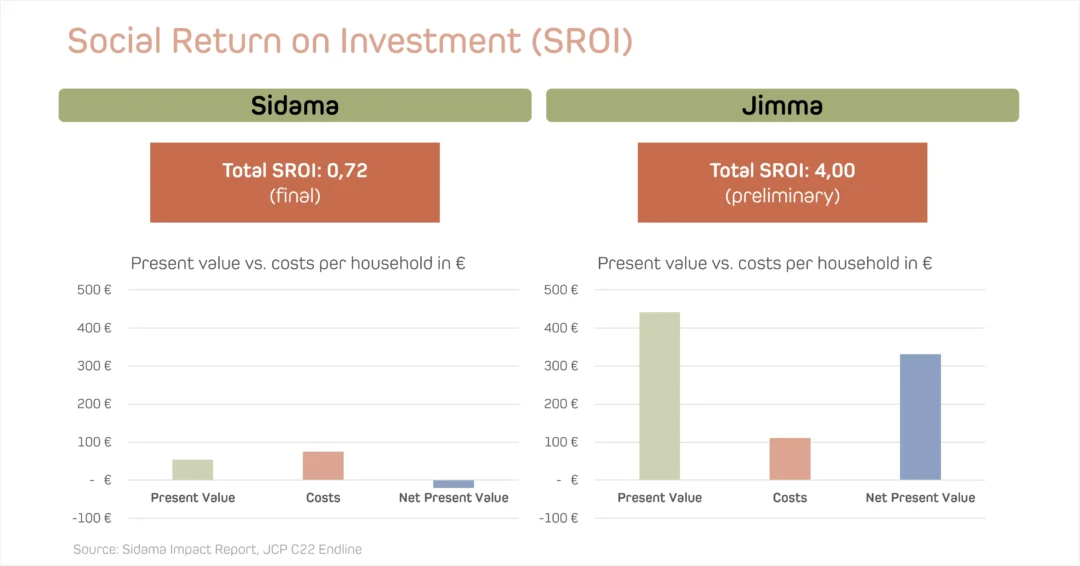
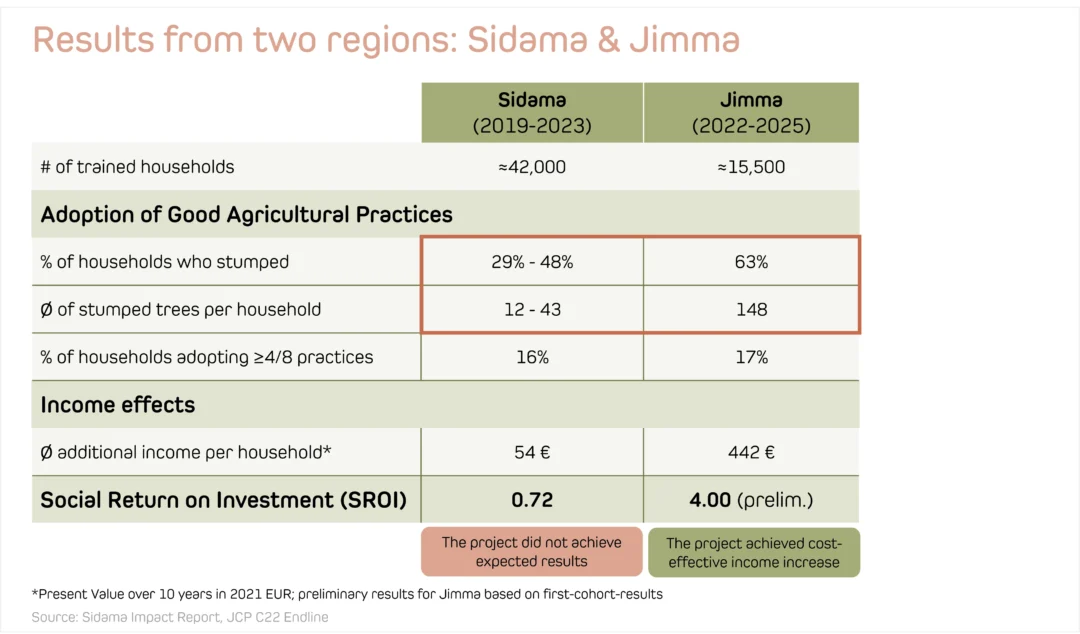
- In Sidama (implemented between 2019–2023), the impact remained limited: The training program improved farmers’ knowledge and achieved a modest increase in adoption of coffee agronomy practices. Stumping incentives were piloted over the course of the project and rolled out in the second cohort, leading to higher stumping uptake. But overall adoption intensity remained too low to generate meaningful income gains. With a Social Return on Investment (SROI) below 1, the program costs exceeded household income gains.
- In Jimma (implemented between 2022–2025), uptake of coffee tree rejuvenation through stumping — one of the most relevant practices for boosting productivity in the Ethiopian context — has been significantly higher. Evidence from the first cohort (C22) shows strong adoption and large numbers of rejuvenated trees per household. With these outcomes, the program is on track to deliver a cost-effective return of 4, meaning for every euro invested, farmers gain four euros in income. Results from the second cohort (C23) are expected next year.
These findings highlight: context and adoption intensity matter as much as the program design itself.
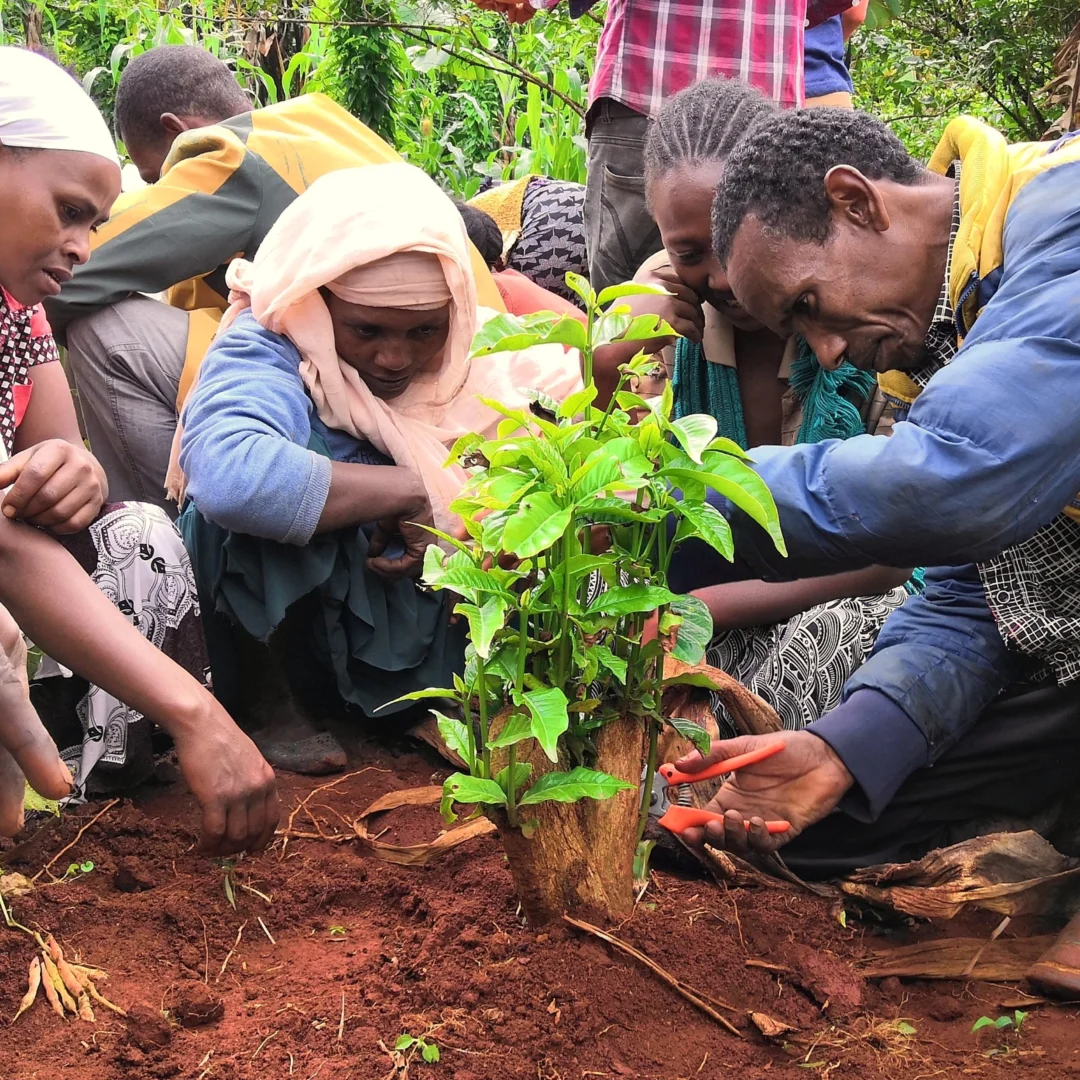
Stumping is a farm practice used to rejuvenate old coffee trees and increase productivity. Farmers cut back the old tree and allow new shoots to grow. They usually face a harvest loss for one to two years, but after that yields are expected to recover and exceed previous production.
This practice is specially relevant in the Ethiopian context where coffee trees are very old and less productive. Therefore, stumping was an main focus in TechnoServe’s Coffee Farm College.
Sidama Coffee Program:
When uptake remains limited
Implemented between 2019 and 2023 by TechnoServe, the Sidama Coffee Program reached around 42,000 households (≈67,000 farmers) – exceeding the objective of 50,000 farmers despite the Covid-19 pandemic during that time. The program focused on group-based agronomy training designed to improve coffee productivity and farm resilience.
While evaluation results confirmed that knowledge improved and adoption of certain good agricultural practices (GAPs) increased, the overall intensity remained low. For example, stumping uptake significantly increased to 29% in the 2019 cohort and 48% in the 2020 cohort with very low adoption rates at program start (around 5%). This increase between cohorts was mainly driven by the roll-out of stumping incentives in the second cohort after successful piloting. However, households stumped only 12–43 trees on average, which is well below the threshold needed for a transformative income effect.
Due to the rather low adoption intensity, the impact on productivity and income is expected to be limited. The program “did not fully achieve expected outcomes” – as the Impact Report states – and its Social Return on Investment (SROI) fell below 1, meaning it was not cost-effective (read more about our SROI methodology in this article).
Although project outcomes were somehow limited, TechnoServe tested several innovations in close collaboration with Laterite and generated valuable learnings how to constantly improve – including stumping incentives and a farmer support model.
Jimma Coffee Program: A stronger outcome trajectory
Building on lessons learned from Sidama, the Jimma Coffee Program was launched in 2021 with a more comprehensive design and in an intentionally selected coffee-growing region. The project contained the following components:
- Coffee Farm College training,
- Group-level access to farm tools,
- Tools as incentives for stumping,
- Coffee washing station trainings to improve quality, and
- Diversification through beekeeping trainings.
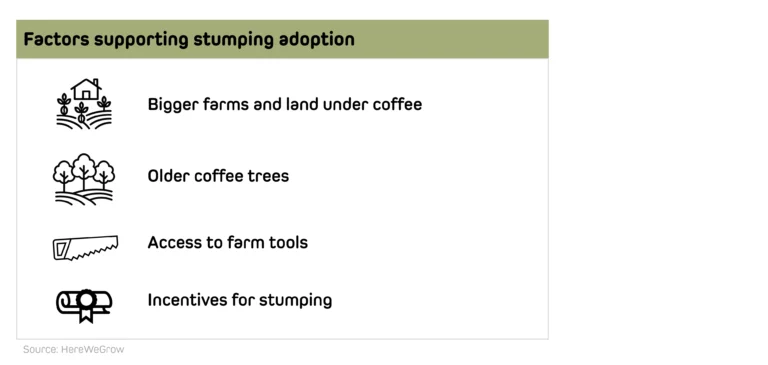
Jimma was selected as the project region for its slightly larger coffee farms (0.6 ha in Jimma vs. 0.35 ha average coffee farm size in Sidama), older trees and high income relevance of coffee.
The program targeted about 15,500 households (≈21,000 farmers) in three woredas (Ethiopian administrative entity) and set a clear adoption goal: at least 60% of trained households stump 50 trees or more.
Evidence from the first cohort (C22) shows strong adoption of stumping with 63% of households stumping. Adoption of other practices remains limited. Under current assumptions, the program’s SROI is estimated at 4 – that means, for every euro invested, the program is expected to generate four euros in additional income at household level. This is impact is estimated based on several assumptions, including yield effects of stumping where we are still facing data gaps and uncertainties (explore the full SROI calculation here).
Results for the second cohort (C23) are expected in 2026, which will provide further evidence on the program’s impact trajectory.

Why the difference? Context and Program Adaptations
The different results in Sidama and Jimma underscore three lessons:
1. Context matters.
The two projects operated under different conditions:
- Sidama: smaller farms, diverse livelihoods, disruptions from COVID-19.
- Jimma: larger farms, older coffee trees, and complementary government stumping campaigns.
From the data we know: households with larger farm sizes tend to stump more trees — generating the scale required for tangible impact.
2. Stumping intensity determines cost-effectiveness.
- In Ethiopia’s context of aging coffee trees, rejuvenation through stumping is a key driver of yield and income gains.
- Evidence shows that widespread adoption alone is not sufficient: meaningful impact depends on stumping being implemented at adequate intensity.
- In the Sidama project, for example, the first farmer cohort would have reached break-even (SROI = 1) if stumping intensity had been tripled.
3. Design adaptations make a difference.
Key elements that support higher adoption and intensity include:
- Intentional region selection based on farm characteristics
- Provision of basic tools for stumping (saws, secateurs) at group level
- Introduction of tools as stumping incentives
Most likely, additional factors such as cultural norms or past stumping experience influence adoption, although these cannot be confirmed through available data.

Looking ahead
This comparative analysis of Sidama and Jimma is not about success versus failure — it is about learning and how evidence can guide better program design.
- Sidama showed that training alone is insufficient if contextual constraints remain unaddressed.
- Jimma demonstrates that with the right enabling conditions and design adaptations, the same approach can deliver cost-effective outcomes.
At the same time, several questions remain:
- When are incentives required to promote stumping and what are the most cost-effective modalities (e.g., type of incentives, thresholds, verification system)?
- What are the long-term yield effects of stumping under Ethiopian smallholder conditions?
- Do farmers continue stumping after program support ends? How do we assure durability of impact?
- How can farm renovation through planting of new varieties complement stumping?
- How can we enhance adoption of other agronomic practices given limited access to inputs and capital to ensure consistent yield effects?
We do not have all the answers yet – but we are committed to finding them. With our partners, we will keep testing, learning and refining solutions to improve the incomes of coffee farmers and their families – with evidence.
RESOURCES
Curious to dig deeper into the results?
If you would like to discuss the findings, share insights or collaborate, please get in contact.
Sidama Impact Report
Jimma Endline Report (C22)
Sidama SROI Calculation
Jimma SROI Calculation