

Laterite’s independent review of 100WEEKS data shows promising results and evidence potentials
Summary of findings
- An independent review of 100WEEKS’ monitoring data by Laterite shows that 100WEEKS’ cash-plus program delivers strong gains in consumption, resilience, and asset-building – especially for the lowest-income households.
- As higher consumption typically reflects rising real income for poor households, these improvements signal meaningful progress toward income goals.
- The model achieves an estimated SROI of almost 3 and a 44% increase in daily per-capita consumption (+0.8 USD), but at a relatively high cost per household (around USD 1,700).
- Internal monitoring data indicates meaningful impact, though the limited rigorous external evidence indicates that true impact is likely overstated.
- For coffee companies navigating Living Income commitments and upcoming CSDDD requirements, targeted approaches like 100WEEKS could play a strategic role, especially to lift most vulnerable farmers out of extreme poverty.
Who and what is 100WEEKS?
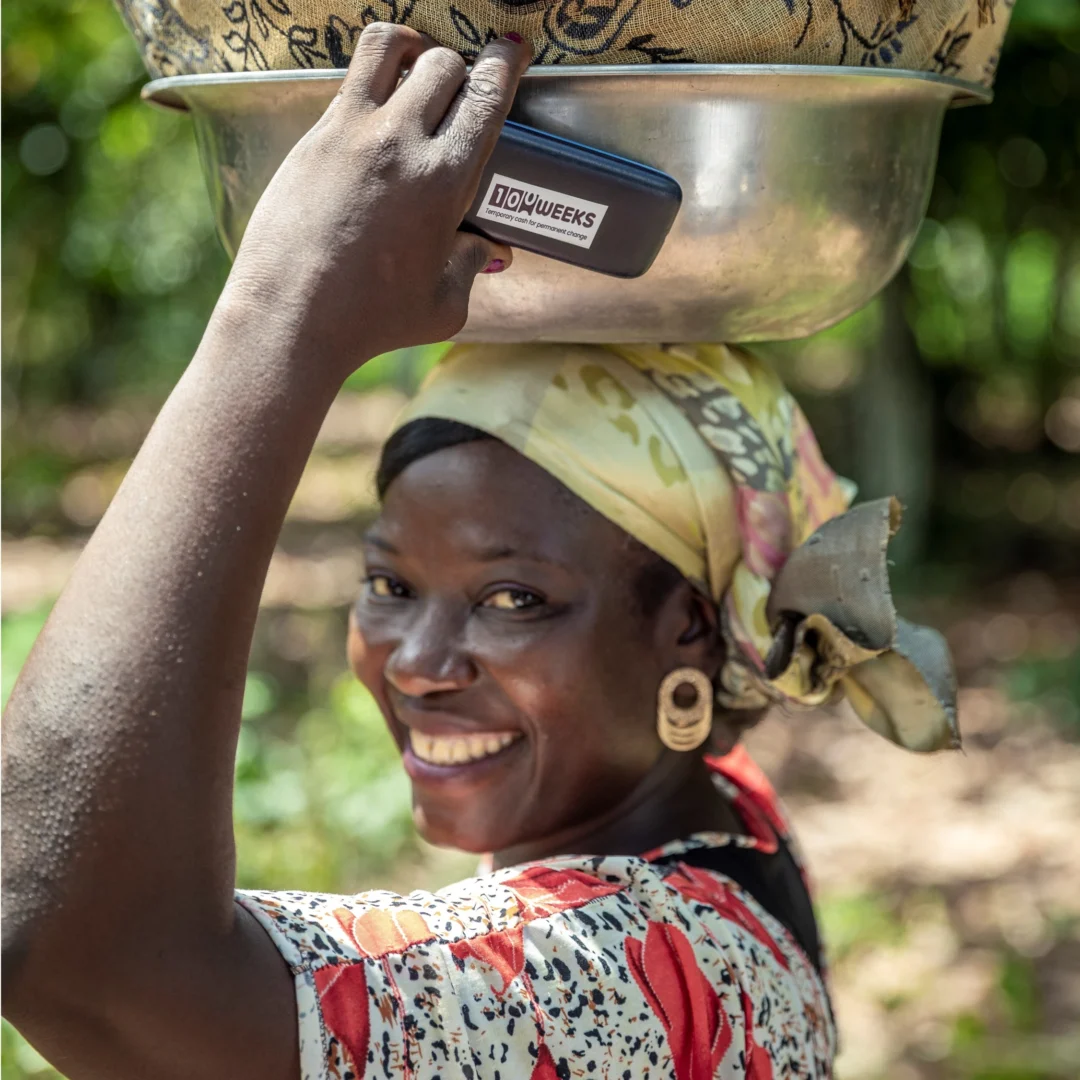
100WEEKS is an organization that implements a “cash plus program” that gives women living in poverty the means to build a more secure future. Over 100 weeks, participants receive weekly mobile-money transfers of 8 USD and take part in practical trainings on financial literacy, entrepreneurship, and household decision-making. They also join Village Savings & Loan Associations (VSLAs), creating long-term savings habits and access to small, strategic investments (see 100WEEKS Theory of Change below).
Working mode
100WEEKS works in several African countries across coffee and cocoa value chains, partnering with traders, local partners and donors. They often use existing relations of farmer networks in supply chains of traders. Its model is gaining relevance as global supply chains place increasing weight on Living Income — and as companies prepare for the EU Corporate Sustainability Due Diligence Directive (CSDDD).


Why HWG partnered with 100WEEKS and Laterite
At HereWeGrow, we look for approaches that increase household income in a cost-effective way – especially for coffee-farming families navigating economic volatility. To better understand the potential of 100WEEKS, we commissioned an independent data review by Laterite.
Our question was straightforward:
Can this model meaningfully increase incomes for rural households, and under what conditions might it be relevant for coffee communities?
What the data tells us
Laterite’s findings paint a compelling picture.
According to 100WEEKS internal data, households in the program show clear improvements in food security, assets and basic living standards. Importantly, the poorest households experience the strongest gains, signaling the program’s ability to reach families often missed by traditional supply chain interventions.
However, the conclusions are weakened by the lack of credible and rigorous counterfactual studies. Without these, it is difficult to attribute the observed changes solely to the 100WEEKS program. Internal data suggest positive progress, but independent evidence is still limited.
The review also notes a need for stronger data collection on income and consumption to better capture households’ monetary living standards. Understanding long-term financial effects will be essential for assessing the model’s relevance in agricultural settings and for aligning it with Living Income goals.
Income and SROI – how much more? And at what cost?
Two indicators guide HWG’s assessment of approaches:
- How much household incomes rise, and
- How cost-effective the intervention is.
For the latter, we are applying the concept of Social Return on Investment (SROI), estimating income gains for farmers for every dollar invested (learn more about our SROI methodology here). Based on monitoring data, Laterite modelled a SROI of 2.99 – meaning every 1 USD invested generates nearly 3 USD in long-term benefits for project participants, with the largest payoffs for the lowest-income households.
Consumption levels of participants were lifted by an impressive 44% – but, delivering these gains comes at a high cost (about 1,700 USD/household). This raises an important question for both funders and companies: how should we weigh deep impact for fewer households against broader but lower impact for more people? The answer depends on your strategy and target group.

Does the approach matter for the coffee sector?
The coffee sector is increasingly judged on their ability to demonstrate verifiable impact, e.g. toward a Living Income of farmers in their supply chain. With CSDDD on the horizon, this pressure will only intensify.
For households facing severe constraints — those furthest from the Living Income threshold — a cash-plus model like 100WEEKS may offer a meaningful pathway. The value lies not in low cost, but in unlocking income gains for a target group which is often left behind in typical coffee supply chain programs. Given its cost structure, this model is best seen as a targeted, high-impact solution for the households most in need.
We’d love to hear from you:
👉 Could a cash-plus intervention strengthen your supply-chain strategy?
👉 Where do you see the greatest opportunities — or barriers — to applying this model in coffee-growing regions?
Let us know!
Read the entire Laterite report